


Coworking and Shared Office Space in India | HuntOffices
Your next work space is waiting for you
Your next work space is waiting for you
Discover Workspace
Private
Office

Flexi
Desk

Dedicated
Desk

Day
Pass

Virtual
office

Meeting
Rooms

Popular Cities





A Few Words from
Happy Clients
I would highly recommend HuntOffices as they were extremely professional and incredibly helpful in our entire office space search. I just wanted to thank you for your help in finalizing the office space,you have really gone out of your way to help. Your assistance, patience and time has been greatly appreciated, I will highly recommend HuntOffices for office space search.

Very professional service by Mr. Mihir! He played the role of a fair mediator keeping both mine and coworking space interest in mind, will definitely use their services next time. He was proactive in keeping us informed throughout the process which made our transaction a smooth experience.

Thanks, HuntOffices for provide various options for Coworking space in central Delhi based on our organization’s requirement, location and budget. Their contribution went a long way in allowing us to have a cost effective, option for our organisation as desired. Mihir, who was leading our office space requirement was very approachable and agile in his interactions and he made sure we got what we want, with in our budget and preferred location.

My experience was quite good with the HuntOffices team, they were professional in their approach and were not imposing for any specific option. Mihir who was leading the transaction was brilliant in his approach. I wish them best of luck in their endeavours.

It was a wonderful experience to deal with HuntOffices team and especially Mr. Mihir who is highly professional in his work and has great skills to manage the clients! He Showed me many options and managed the best value for money deals for me. Keep it up and all the best.

We had a great experience in finding the desired office space with HuntOffices. The team was a great help in getting various options within our requirement & budget. Would highly recommend their services.

I was looking for an office space in Gurgaon. Then I got in touch with HuntOffices which has the most extensive search features, wide range of property listings and information with which I felt comfortable. I was able to find the perfect office to meet all my needs, with lots of flexibility and amenities. Thank you HuntOffices.

I wanted to thank HuntOffices for all their work in helping me find office space in Gurgaon... Their professionalism and guidance throughout the process was excellent and I wish the best for them both professionally and personally. It was a pleasure working with them-- Thanks again!

Connected to India is a Singapore headquartered online media company. We looked at HuntOffices listing to find a suitable location for our India office in New Delhi. We found a lot of choices in their listing. Various permutations and combinations from serviced to rental and so on. Post which HuntOffices team did a great job of orgainising visits and chaperoning us on the visits until we zeroed-in to the option, which worked best for us.

In our business our schudules are erractic and work may need to happen around the clock. We wanted a office with flexibility of accomodating additional heads when work peaked. We gave the HuntOffices team the challange of find such an office for us that we would wok 24/7. The website give the largest no of options and the team found the right solution with our budget.

Our business was growing rapidly so was the need to scale up office space. Found the right options on HuntOffices.com. The team reached out, understood our needs, showed us just the right options with possiblility of future expansion. Negotiated with the provider and we moved in. Really appricate the professionalism of the HuntOffices team.

HuntOffices.com was a breeze to use, view and shortlist office options. The team got us the right office within the budget we wanted with the facalities we expected. We were up and running in our office within 7 days of starting the process.

Our search for centrally located business centres with good meeting rooms lead us to the HuntOffice portal. Shortlisting, Viewing and moving in was managed in a manner that was beyond expectation. The HuntOffices team is efficinet and very helpful.

HuntOffices is a great platform to search for offices. I got all the assistance required while choosing my office from the HuntOffices team. All parameters like desired office location, amenities and most importantly the budget were taken care of diligently. Highly recommended and excellent knowledgeable service provider. Thank you HuntOffices!

The experience with HuntOffices has been exceptional. When I began sousing for my office location, I posted a query on the HuntOffices website. Post the query posting I was guided to the property as per my requirement and I finalised the location of property in one sitting.

HuntOffice helped us a lot to search good & budgeted co working place.

Have a vacant space convert it to coworking office and list with HuntOffices?
30 Cities
40 Clients
600 Locations
6000 Workstations
Check out our
latest article
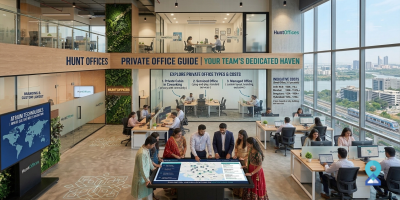
Private Office Space in India: Cost, Types and Best Options
Quick answer: A private office is a closed room for your own team. You get privacy, your own desks and shared services like reception and meeting rooms. The main types are private cabins, serviced offices and managed offices. A small office for 3 to 5 people often costs ₹25,000 to ₹1,25,000 a month. The price depends on the city, building and services.Do you need a quiet place for your team and client calls? Private office space in India is a good fit. It gives you more privacy than a shared desk. It also has far less hassle than a long lease. This guide explains the types, the cost by city and how to choose.What Is a Private Office?A private office is a closed room used by one person, one business or one team. Unlike an open desk in a coworking space, it gives you more privacy.You can lease a standard commercial office. Or you can rent a flexible one run by a provider. A flexible office usually has furniture, internet, cleaning, reception and meeting rooms. Private office space for rent suits startups, consulting firms and growing teams. It also suits larger firms that want a professional base without running it themselves.Types of Private Offices in India1. Private cabin in a coworking spaceA private cabin in a coworking space is a closed room just for your team. You share the lounge, reception and meeting rooms with other members.Best for:Startups and SMEs that need privacy.Consultants who meet clients often.Teams that want their own room in a pro setting.2. Serviced officeA serviced office is fully set up, and the provider runs the services. It comes with furniture, internet and cleaning. It is plug and play. Firms do not need to buy furniture or manage repairs.Choose it if you want:A fully furnished office.A professional business address.A quick, easy move-in.3. Managed officeA managed office is an exclusive space built around your needs. It can have your branding, a custom layout, conference rooms and your own tech. A firm looking for managed office space in Bangalore will weigh tech hubs, staff commutes and room to grow.Best for:Medium and large organisations.Firms that want a custom layout.Firms that open offices in many cities.Private Office Space Cost by City in IndiaCost depends on the area, building, services and contract length. The table shows rough budgets for a small office for 3 to 5 people.CityIndicative monthly costDelhi NCR₹30,000 to ₹1,00,000+Mumbai₹40,000 to ₹1,25,000+Bengaluru₹30,000 to ₹90,000+Hyderabad ₹25,000 to ₹75,000+Pune₹25,000 to ₹70,000+Chennai₹25,000 to ₹70,000+What Affects Office Rental Prices?Each city has its own business areas. Look at the whole cost, not just the monthly quote.Delhi NCR: Connaught Place and Gurugram offer strong addresses and links. Prices vary by area and building.Mumbai: Prime areas like BKC and Lower Parel cost more. Read our guide to coworking space in Mumbai for area tips.Bengaluru: Tech hubs like Whitefield and the Outer Ring Road are popular. See our Bangalore coworking guide.Hyderabad: HITEC City, Madhapur and Gachibowli suit tech firms. Prices vary by building. A private office space in Hyderabad is often cheaper than one in Mumbai. Read more in our Hyderabad guide.Pune: Kharadi, Baner and Hinjewadi serve tech and service firms.Chennai: The central business districts and Old Mahabalipuram Road suit different needs. A private office space in Chennai is often easier on the budget.Private Office vs Coworking vs Virtual OfficeEach option has a different job. Pick by team size, and by whether you need a space or just an address.FactorPrivate officeCoworking deskVirtual officeWorkspaceEnclosed, dedicated roomShared or fixed deskNo permanent deskPrivacyHighLimited in shared areasNot applicableBest forTeams and confidential work Freelancers and hybrid workers Firms that need an addressMeeting rooms Included or charged extraShared and bookableOften an add-onPricingOffice or per-seat feeUsually per deskUsually a service feeA private office suits teams that want a steady space and more control. A coworking space private office or cabin is a middle path. A virtual office works when you need an address and services but no desk.How to Choose the Right Private OfficeDo not just compare rent. Use this checklist.Team size. Count your people. Plan for desks, meeting rooms, storage and growth.Location. Check the commute, transport, parking and distance to clients.Services. Ask if the price covers furniture, internet, reception, cleaning, utilities, security, meeting rooms and tech support.Contract terms. Check the lock-in period, deposit, notice period and the option to add seats.Privacy. Visit the office. Check light, air, noise and internet. Firms with private data need strong security.Total cost. Add up the rent, deposits, taxes, extras and set-up costs. For a standard lease, add fit-out, furniture and upkeep.Frequently Asked QuestionsHow much does a private office cost in India?A small private office for 3 to 5 people often costs about ₹25,000 to ₹1,25,000 or more a month, depending on the city, building and services. Mumbai and Delhi NCR are usually the highest. Always ask for a written quote.What is the difference between a serviced office and a managed office?A serviced office is furnished and ready to use, with services run by the provider. A managed office gives you more control over layout, branding and technology, and suits larger teams.Can startups rent a private office?Yes. Many operators offer small private cabins for startups. Availability and minimum stay vary by centre.Should I choose a private office or coworking?Choose a private office if you handle confidential work or need a stable space for a team. Choose a coworking desk if you are happy to work in a shared area.What should I check before signing an agreement?Check the price, deposit, services, taxes, notice period and lock-in period. Get all terms in writing.Find the Right Office Space with HuntOfficesStart by deciding what you need for your people, location and budget. Then compare a few offices and read the agreement with care.HuntOffices can match you with the right office for your area, team size and budget. Want a small cabin, a serviced office or a custom space? We can help you shortlist.Ready to find your private office? for free shortlisting and site visits.
Read More
Celebrate Navratri at Your Coworking Space
Quick Answer A Navratri celebration in a coworking space allows professionals to enjoy the festival while building stronger relationships at work. From decorations and ethnic dress days to games and music, there are many Navratri office celebration ideas that coworking spaces use to bring people together. The well-arranged Navratri celebration in the coworking place makes it easy for the freelancers, startups, and even the corporations to observe Navratri without affecting their schedule. Introduction Navratri represents the spirit of faith, positive thinking, and the victory of good over evil. This festival in India is celebrated in terms of wearing traditional clothes, music, and dance. Bringing all these traditions to the work environment creates a chance for colleagues to socialise outside of work. The Navratri celebration in coworking space provides a realistic approach to organising such events without requiring any separate corporate event space. With appropriate settings and activities in place, companies can plan their own event celebration without affecting work productivity. Why Celebrate Navratri at a Coworking Space? Navratri celebrations in coworking space increase the possibility for different professionals in coming together for networking and socialising. Celebrating together is one way to create bonds within the workplace through cultural interaction in a fun work environment. Key benefits include: Better interpersonal relationships: Build improved relations amongst colleagues, not only limited to the project sessions. Cultural interaction: Educate and inform participants about Navratri – a traditional folk cultural festival of India and a time for people to enjoy music, dances and games. Flexibility: Based upon the number of people coming in, decide the space which will be most suitable to hold all the activities. Healthy workplace culture: To make the environment pleasant and people friendly, it is good to get people together and have common experiences such that people start feeling part of a group. For companies without a dedicated events area, a Navratri celebration in a coworking space can be a convenient way to host coworking space festival events in a professional setting. How Coworking Spaces Make Navratri Celebrations Easy Planning a Navratri event at a coworking office is quite simple if the space comes equipped with suitable facilities and allows for bookings to fit different schedules and needs. By utilising meeting rooms, collaborative areas, seating area, and also lounge area according to the facilities that the venue gives, companies can make the use of the coworking office for various purposes easier. It becomes a matter of course that businesses do not need to look elsewhere. There are six ways how workplace premises can enable you to celebrate an official workplace Navratri event: Available amenities: Check whether the venue provides you with the number of chairs needed, a reliable internet connection, access to screens, and the pantry (for snacks). Bookings: You can go for bookings depending on one hour, three hours, half a day, full day, etc., where possible. Minimises hassle: The fact that the organisation team can focus on the celebration at the office rather than searching for an alternative venue is a great advantage. Engagement of the whole office community: By offering other members an opportunity to join in approved activities as well, the business can foster professional relationships. Client-centred parties: Get everyone on board with a celebration that is appropriate for the setting of work of colleagues or customers alike at a professional place. Festive Workspace Decor Ideas With proper decorations, one can make the Navratri celebration in a coworking space without disturbing the workings of your workplace. Remember that you must utilize recyclable material for decorations, provide open access to common areas and consult with the workspace manager prior to decorating the venue.Some of the festive workspace ideas for your workspace and common places include colorful welcome corner, ethnic dress-up day, decoration corner, refreshment counter, cultural presentation and festive message board. Who Benefits Most: Freelancers, Startups and Enterprise Teams? A Navratri celebration in a coworking space is perfect for people who may work in diverse ways, such as freelancers or teams in corporations. However, the most appropriate venue depends on factors such as the number of attendees and the purpose of the event. Freelancers: Community celebrations offer chances to socialise, network with other professionals, and participate in festivities outside the comfort of one’s home. Startups: Small groups can organise fun quizzes, dressing up according to ethnic cultures, snacks and group photos without requiring a permanent office at all times. Enterprise teams: In larger firms, cultural events may be planned in a structured way, based on available space and other such considerations. Remote and hybrid teams: Use a combination of offline events and online quizzes or greetings for your remote employees. For all such groups, having a Navratri celebration in a coworking space will result in memorable experiences for them both professionally and culturally. What to Look for in a Coworking Space for Festive Events Selection of the right space becomes very important when planning Navratri celebration in the coworking space. During selection, it becomes very important to find out whether the coworking centre has sufficient space for entertaining you. Consider these factors: Capacity and layout Location and accessibility Facilities and equipment Booking flexibility Event policies Budget transparency Knowledge about all these things will assist you in making plans for your Navratri celebration in a coworking space without any unexpected expenses or difficulties. Best Coworking Spaces for Festive Events: Delhi NCR, Mumbai and Bengaluru Workplaces in Delhi, NCR, Mumbai, and Bengaluru offer a wide range of options in established commercial zones and upcoming business centres. For arranging a celebration of Navratri in a coworking place, take into consideration the location of your office, the number of people involved, and the facilities required. HuntOffices helps you explore various workplace options in different locations, while individual operators help arrange events. Coworking Space in Delhi NCR Coworking offices in Delhi should also keep in mind good connectivity, accessibility of the facility, and appropriate gathering places. Various organisations in Delhi NCR will also find it easy to make a comparison between locations in Gurugram and Noida according to their team needs and convenience of reaching the place. It is also easy for a business to organise a Navratri celebration in coworking spaces. Coworking Space in Mumbai When selecting the coworking space in Mumbai during Navratri, keep in mind the commuting time, the size of the space, and the total cost of the event. Moreover, it offers you a well-furnished conference room or multipurpose room as per your requirement for your small group meeting. Coworking Space in Bengaluru A Coworking Space in Bengaluru suits start-ups, technology companies, and even existing organisations. Select the place considering factors such as accessibility, arrangement of seating, audiovisual arrangement, and selection of hybrid participation. Frequently Asked QuestionsHow to select a coworking place during Navratri?Location, facilities, flexible memberships, and special events can help select a good coworking space for Navratri.What criteria should business entities consider when selecting a coworking space during Navratri?Look for comfortable work areas, meeting rooms, reliable internet, and facilities that support festive workspace ideas without disrupting work.What are some Navratri office celebration ideas for coworking spaces?Popular Navratri office celebration ideas and Navratri team activities include ethnic dress days, festive quizzes, rangoli displays, and team gatherings.Do you provide Navratri offers for the booking of coworking spaces?This may depend upon the provider. Enquire with the service provider to learn more about the Navratri offers for booking of coworking spaces.How can companies celebrate Navratri in their workplaces without compromising productivity?Arrange activities during break times or after completing the work and do not disturb other employees.Where should you look for a coworking space during Navratri?Select between a coworking space in Delhi, coworking space in Mumbai, or coworking space in Bengaluru depending upon accessibility, facilities, and cost factors.How do you find a coworking space for Navratri celebration?Compare flexible workspace options and check whether the provider permits coworking space festival events before booking.Celebrate Navratri with HuntOfficesLooking for an appropriate place to work during the festive season? HuntOffices assists in the search for coworking and flexible workspaces that may suit your needs. Check out HuntOffices for information on available workplaces and choose one that meets your requirements. Contact the appropriate service providers for availability of events. Let this Navratri be the time for you to make the choice regarding the space of your business and improve your professional connections.
Read More
Best Coworking Spaces in Navi Mumbai (2026 Guide)
By Hritik | Hunt Offices Navi Mumbai Coworking Guide | Last updated: October 2026Quick AnswerFinding the best coworking space navi mumbai has to offer requires comparing commute options, privacy preferences, and budget considerations. Some of the top shared office spaces with listings of available seats are Awfis Cyber One and WeGrow Proxima in Vashi, Enjoy Coworking in CBD Belapur, Co-Works by STM in Kharghar, and Awfis Empire Tower in Airoli. Publicly listed prices start from ₹4,000 to over ₹14,000+ per seat per month, with Vashi averaging at ₹8,100 per seat. The cheapest prices are available in Vashi at ₹4,000 per month and Kharghar at ₹4,999 per month. Pick Vashi or Belapur for the best rail connectivity, or Airoli for proximity to major tech parks.IntroductionNavi Mumbai is one of the most competitive business districts in Mumbai Metropolitan Region (MMR) due to its mix of affordable commercial realty and superior transport connectivity. According to Cushman & Wakefield’s 2025 commercial real estate report, the city sustains 23.8 million sq ft of Grade-A office space stock, comprising nearly 20% of the total MMR inventory. Vacancy rates remain subdued at over 87%, with average monthly rents in Thane-Belapur and neighbouring areas hovering between ₹70-77 per sq ft.The upcoming Navi Mumbai International Airport (NMIA) commissioning by late 2025 has accelerated demand in the region, complemented by Mumbai Trans Harbour Link (MTHL / Atal Setu) and metro infrastructure development.IndiatimesInstead of long-term commercial leases, independent professionals, start-ups, and corporate satellites are preferring a coworking space in navi mumbai that offer flexible seating options, premium services, and cost savings on fit-out expenses. This guide covers the best flexible workspaces in Vashi, CBD Belapur, Kharghar, and Airoli with their pricing, amenities, and selection criteria. Whether you need a single desk or a full team floor, a co working space in Navi Mumbai can be set up quickly. Top Coworking Spaces in Navi MumbaiThe rates listed below represent monthly pricing per seat, based on publicly available data. Prices are subject to change depending on the contract value, team size, additional security requirements, and online booking portal discounts. Use the listed figures as a indicative range and request a detailed quotation before finalising your booking. These figures cover the main coworking spaces in Navi Mumbai across every micro-market.VashiAs the commercial gateway to Navi Mumbai, Vashi hosts the majority of shared office spaces and corporate towers.1. Awfis Cyber One.Offering some of the largest managed office space in Vashi, this centre is located on the 18th floor of the Cyber One building in Sector 30A.Pricing: ₹8,999 – ₹12,777 per month (flexi, dedicated, or private cabin)Features: 4.4-star rated (119+ reviews), open 6 days per week (8:00 AM to 8:00 PM), enterprise-grade suites, warm-shell customisation, fully-furnished, and high-speed internet. Managed agreements require a 1-year tenure, ideal for teams of 6+ members.2. Awfis Raghuleela.This centre is located in the Raghuleela Mall complex, right next to Vashi Railway Station.Pricing: ₹8,000 per month per seatFeatures: 4.4-star rating (200+ reviews), core-breakout layout, meeting rooms, admin support, and excellent rail connectivity.3. WeGrow Proxima.A boutique flexible workspace located on the 8th floor of Plot 19, Sector 30A.Pricing: ₹6,999 per month for a dedicated desk or ₹10,000+ per month for a 4-5 seater cabinFeatures: 39-desk capacity, private-office environment, no long-term contracts, open 7 days per week (8:00 AM to 9:00 PM), 2-wheeler and 4-wheeler parking, power backup, and pantry services.4. Apna Cowork (800 Jubilee).One of the highest-rated independent workspaces in Vashi, popular among freelance consultants and tech professionals.Pricing: ₹7,000 per month per seatFeatures: 4.9-star rating (Nearly 100 reviews), high-speed Wi-Fi, 24×7 security, car parking, and affordable pricing compared to enterprise-grade operators.5. TriggerXchange.A modern flexible office space suited for small agencies and corporate teams.Pricing: ₹9,499 per month per seatFeatures: 4.5-star rating, fully-furnished conference rooms, building security, parking, and flexible membership plans.6. Worqspot Coworking.A budget-friendly flexible workspace located within Vashi’s commercial belt.Pricing: ₹4,000 per month per seatFeatures: Lowest-priced coworking space in Vashi, ideal for solo professionals and small teams looking for a dedicated desk on a tight budget.CBD BelapurAs the administrative hub of Navi Mumbai, CBD Belapur is home to some of the best coworking spaces in the city. Professionals prefer this district for its premier institutional infrastructure and transport connectivity7. Enjoy Coworking Space.This is one of the most popular shared office spaces in CBD Belapur, located within the Belapur Railway Station complex in Sector 11.Pricing: ₹8,499 per month per seat for dedicated desks or 3-seater cabins. Day passes also available.Features: Over 250-seat capacity, open 6 days per week (10:00 AM to 8:00 PM), no long-term contracts, 4-wheeler parking, high-speed Wi-Fi, printing facilities, complimentary tea/coffee, temperature-controlled environment, power backup, and fully-furnished conference rooms.KhargharCompared to Vashi and Belapur, Kharghar offers a more affordable real-estate pricing with emerging infrastructure projects. It is one of the most preferred locations for a cheapest coworking space in navi mumbai.8. Co-Works by STM.A value-for-money flexible office space located at Kamdhenu Commerz, Sector 14.Pricing: ₹4,999 per month per seat for dedicated desksFeatures: Open 6 days per week (9:30 AM to 8:30 PM), no long-term contracts, fully-furnished meeting rooms, 2-wheeler and 4-wheeler parking, tea/coffee service, printing facilities, power backup, and fast-track approvals (move-in within a week).AiroliAiroli is the technology and engineering capital of Navi Mumbai, housing corporate offices of Mindspace, Reliable, Gigaplex, and other IT parks9. Awfis Empire Tower.This centre is located within Reliable Tech Park, best-suited for tech professionals, corporate executives, and IT consultants.Pricing: Day passes start at ₹600/day, meeting rooms from ₹634/hour, and private day offices from ₹1,107/hour.Features: Open 6 days per week (8:00 AM to 8:00 PM), 24×7 security, breakout lounges, high-speed printers, projectors, and beverages. Similar tech-focused coworking spaces are available at Gigaplex IT Park and Raheja Mindspace.10. Empire Business Centre and EFC.Pricing: The Empire Business Centre offers premium managed seats from ₹14,399 per month, while EFC has enterprise-grade flexible seating from ₹7,999 per month.Features: Grade-A infrastructure with soundproof cabins, dedicated IT infrastructure, boardrooms, and concierge services. Along the Thane–Belapur Road belt11. Regus.Major flexible office space brand with listings in Mahape (starting price: ₹8,773 per month) and Turbhe (starting price: ₹10,490 per month). Global network of business lounges, day-use meeting rooms, and excellent rail connectivity.12. Work Square, Rabale.Located within Sigma IT Park, best-suited for mid-sized back-office operations.Pricing: ₹7,499 per month per seatFeatures: 3.8-star rating (1,000+ reviews), flexible desk plans, and scalable floor space options.13. Other options.Kontor Space (Millennium Business Park, Mahape): ₹10,000 / seat / monthInnov8: ₹10,000 / seat / monthYesssWorks (Aurum Q6, Ghansoli): ₹9,000 / seat / monthAwfis (Aurum Q Parc, Ghansoli): ₹12,000 / seat / monthTrackster Cospaces: ₹5,500 / seat / monthNetsilik Software: ₹6,000 / seat / monthQuick comparisonS.No. Centre Name Micro-Market Starting Monthly Price Lock-in Period Target Fit 1 Worqspot Coworking Vashi ₹4,000 Flexible Solopreneurs / Freelancers 2 Co-Works by STM Kharghar ₹4,999 None Bootstrapped Startups 3 WeGrow Proxima Vashi ₹6,999 None Small Boutique Teams 4 Work Square Rabale ₹7,499 Flexible Scaling Back-Office Teams 5 Enjoy Coworking CBD Belapur ₹8,499 None Rail Commuters 6 Awfis Cyber One Vashi ₹8,999 ~12 Months Corporate / Enterprise Teams 7 Empire Business Centre Airoli ₹14,399 Variable Premium Corporate Suites Best Locations: Vashi, Belapur, Kharghar and AiroliWith over 4 million sq ft of commercial real-estate transactions expected to occur in Navi Mumbai by FY28, it is critical to identify the right micro-market based on your business needs. Below is a visual guide highlighting the key flexible office markets in Navi MumbaiEach of these areas offers a different mix of coworking spaces in Navi Mumbai, and flexible workspace Navi Mumbai teams rely on is likely to keep growing.Area Known for Airoli Tech and IT hub (Mindspace, Reliable) Vashi Commercial gateway with central connectivity Belapur Financial, legal and government infrastructure Kharghar Low-cost residential and start-up hub VashiVashi has the greatest selection of Grade-A and Grade-B flex space, primarily concentrated in the Sector 30A belt. With Cyber One and Proxima at the centre, average desk rates are guided by ₹8,100 per month. Vashi offers excellent road connectivity to South Mumbai and Central Mumbai via the Vashi Bridge. It is ideally suited for businesses operating across Mumbai and Navi Mumbai. Demand for Vashi office space remains steady, and a coworking space in Vashi is a safe choice for teams that travel across both.CBD BelapurCBD Belapur is the administrative and financial heart of Navi Mumbai, home to corporate offices of banks, shipping companies, government agencies, and multinational corporations. Flexible workspace operators such as Enjoy Coworking are ideally located to serve professionals using the Harbour Line or planning to use the Mumbai-Pune Expressway. For Belapur coworking, a station-side centre keeps the commute simple.KhargharCompared to Vashi and Belapur, Kharghar offers affordable commercial rental rates, making it a preferred micro-market for bootstrapped start-ups and independent professionals. The area is witnessing infrastructure development, including the proposed tunnel project linking Kharghar with Turbhe. A Kharghar shared office is often the cheapest way to start.AiroliAs the northern extension of Thane-Belapur IT belt, Airoli is home to corporate offices of engineering firms, software developers, and IT consultancies. Larger managed desk plans in Airoli are guided by ₹10,000-14,000+ per month, while day office rates start from ₹600 per day. Airoli office space suits technology teams that want to be near larger firms.Pricing and AmenitiesCommercial rent pricing across Navi Mumbai ranges from ₹70-77 per sq ft per month, which is approximately 50-60% lower than the city-centre benchmarks. As a result, flexible office space operators offer highly competitive desk rates, spanning from ₹4,000 to ₹14,399+ per month. Below is a snapshot of amenities available on a day-to-day basis across different flexible office space categoriesAverage monthly cost range by seat tierSeat tier Monthly price Budget desks (Kharghar / Vashi) ₹4,000 – ₹6,000 Mid-range dedicated desks ₹7,000 – ₹10,000 Premium managed / corporate seats ₹10,000 – ₹14,000+ Day pass access (Airoli / Vashi) ₹600 / day Lower office rents help keep prices across coworking spaces in Navi Mumbai below central Mumbai levels. A shared office Navi Mumbai desk usually costs less than a private cabin. For the cheapest coworking space in Navi Mumbai, look at Kharghar and Vashi first.Standard Amenities: Enterprise-grade high-speed internet, central air-conditioning, power backup, ergonomic office furniture, reception desk, daily housekeeping, and pantry services with complimentary tea/coffee.On-request Amenities: Conference rooms (limited daily capacity), high-volume printing/scanning, dedicated telephone lines, and parking allocation.Security & Booking Terms: Security deposit is guided by 1-2 month’s desk payment. Independent flexible office space operators tend to offer month-to-month memberships, compared to enterprise-grade operators (Awfis, Regus) which require 6-12 month prepayments.How to Choose the Right Coworking SpaceChoosing a coworking space Navi Mumbai teams will stay in takes more than comparing prices.When selecting the best coworking space in navi mumbai for your team, it is essential to narrow the search based on the following criteria:Peak Hour Accessibility: Conduct a physical inspection of the shortlisted centres during peak hours to understand the traffic congestion on roads, railways, or other modes of transport.All-inclusive Pricing: Apart from the monthly desk rent, make sure to factor in security deposit, GST (18%), any additional charges for conference rooms, parking, and printing services.Lock-in Period: Always ask about the minimum tenure for membership plans. For start-ups, it is best to avoid long-term contracts and opt for month-to-month payments. For established firms, 6-12 month prepayments could be more cost-effective.Infrastructure & Power Backup: Ask about internet bandwidth (minimum 2 dedicated lines) and power backup (minimum 6-hour backup generators).Soundproofing & Meeting Rooms: Request a private demo to test the noise-cancellation features around phone-rooms, open-desk areas, and conference rooms.Review Ratings & Feedback: Always prioritise coworking spaces with higher overall ratings (100+ reviews) as it reflects long-term guest feedback on quality of services.Scalability: Discuss floor-plans to understand if the operator can accommodate more desks as your team expands or offer private cabins for senior-level executives.FAQsWhat is the best coworking space in Navi Mumbai?It depends on your specific needs and location preferences. Some of the best coworking space in Navi Mumbai are:Awfis Cyber One and WeGrow Proxima in Vashi,Enjoy Coworking in CBD Belapur,Co-Works by STM in Kharghar,and Awfis Empire Tower in Airoli.What is the cheapest coworking space in Navi Mumbai?The lowest prices are available at Worqspot Coworking in Vashi and Co-Works by STM in Kharghar at ₹4,000 and ₹4,999 per month respectively.How much does a coworking space in Vashi cost?Desk prices in Vashi range from ₹4,000 for budget-friendly seating options to over ₹12,777 for premium dedicated cabins. On average, you can expect to pay ₹8,100 per month.Can I get a day pass in Navi Mumbai?Yes, several operators offer day passes. At Awfis Empire Tower in Airoli, day office rates start at ₹600 per day. Is there a shared office for small teams in Navi Mumbai?For small teams, boutique-style coworking spaces with dedicated desks and no long-term contracts are the most suitable. WeGrow Proxima in Vashi and Co-Works by STM in Kharghar are some of the best options for small startups. Shared office Navi Mumbai seats of this kind start from about ₹4,999.Do coworking spaces in Navi Mumbai have a lock-in?It varies from operator to operator. Most independent shared office space operators offer month-to-month memberships. Larger operators such as Awfis, Regus, and Kontor Space may require 6-12 month prepayments for managed desk plans.Find Your Coworking Space in Navi MumbaiYour choice of co-working space in Navi Mumbai ultimately depends on your team’s daily commute, office needs, and budget requirements. To help you find the most suitable options, Hunt Offices offers verified listings of shared office spaces in Vashi, Belapur, Kharghar, and Airoli. We provide transparent pricing, zero brokerage fees, and end-to-end guidance to help you discover flexible desk options in Navi Mumbai.If you are looking for the best coworking space in navi mumbai, request a free site visit today.
Read More
Top MNC Companies in Hyderabad (2026): List, Locations & Workspace Options
By Hritik | Hunt Offices Hyderabad MNC Guide | Last updated: October 2026 Quick AnswerTop MNC companies in Hyderabad are Microsoft, Amazon, Google, Apple, Meta, Salesforce, Oracle, TCS, Infosys, Accenture, Deloitte, JPMorgan, Goldman Sachs, Wells Fargo, Novartis and Eli Lilly. These are located mostly in Hyderabad’s western corridor: HITEC City, Gachibowli, Madhapur and the Financial District. As of March 2026, Hyderabad is home to 515 global capability centres (GCCs) and over 3 lakh employees, per a FICCI-Anarock report, making it close to 20% of India’s total GCCs. For MNCs looking to set up in Hyderabad, a coworking space in Hyderabad is often the quickest and safest way to start.IntroductionAsk any consultant or executive from India’s tech or finance sectors which Indian cities are global MNC magnets and they will say Hyderabad, without fail. Hyderabad has seen an explosion of multinationals, not just in the technology space, but also in pharmaceuticals and healthcare. This has resulted in glass towers dotting the landscape between Madhapur and Nanakramguda, as well as new GCCs opening up in Hyderabad every month. In fact, in the first half of 2026 itself, L’Oréal opened up its first ever GCC in India, as well as its first Beauty Tech Hub.This piece aims to highlight the top MNC companies in Hyderabad, sorted across sectors. For each of these MNC companies in Hyderabad, we have noted down their approximate address and the micro-market they are in. We have also added a section on which clusters are the most sought-after by global firms and why. Hyderabad’s appeal as a destination for MNCs and the various workspaces available to multinational teams, from coworking spaces in Hyderabad for teams of 1 to 30 to private cabins and managed offices, are also discussed.Top MNC Companies in Hyderabad (2026 List)The MNC companies in Hyderabad list below represents a wide range of sectors and has a significant presence in technology, IT services, BFSI, pharma, consumer and more. As of the first half of 2026, we have avoided providing figures on the number of employees for most of the companies mentioned below, as these numbers are known to change on a regular basis.Big Tech and Product Companies1. Microsoft: Microsoft Hyderabad is home to the company’s largest India Development Center. It employs thousands of people who work on a range of cloud, AI, engineering and product development.2. Amazon: Amazon has one of its biggest campuses, outside the US, in Hyderabad. This includes multiple buildings in HITEC City, as well as in the Nanakramguda-Gachibowli belt. It employs thousands of people in cloud, engineering, retail technologies, and operations.3. Google: Google Hyderabad is the company’s largest office outside the US and hosts its heftiest concentrations of product engineers and AI researchers.4. Apple: Apple Hyderabad is one of the top GCCs in the city and is a major draw for hardware and software talent.5. Meta: Meta has offices in Hyderabad, including an expanded presence in HITEC City which saw a recent lease of around 69,700 sq ft.6. Salesforce: Salesforce Hyderabad hosts the company’s development centre, which supports its global operations in cloud and CRM.7. Oracle: Oracle Hyderabad has been around for a long time and has a substantial footprint in the development of cloud and enterprise software.IT Services and Consulting MNCsTCS: TCS Hyderabad is one of the company’s largest offices in India, hosting tens of thousands of employees and spanning multiple facilities.Infosys: Similar to TCS, Hyderabad is home to Infosys’s significant presence in India. The company continues to invest in the local market to meet its clients’ needs.Accenture: Accenture Hyderabad is one of the city’s largest private-sector employers. The company hosts technology consulting and application development teams.IBM: IBM Hyderabad supports the company’s software, consulting and infrastructure needs.Deloitte: Deloitte Hyderabad is a major player in the BFSI and IT consulting space, with a large presence across audit, advisory, technology and analytics.Banking, Financial Services and Insurance (BFSI)BFSI has been one of the fastest-growing sectors in terms of MNC hiring in Hyderabad. Hyderabad accounts for over 50% of all new GCCs opened this fiscal, as per the Nasscom GCC Landscape Report 2026.JPMorgan Chase: JPMorgan Chase is a major technology and operations hub for the company, supporting its global banking operations.Goldman Sachs: Goldman Sachs has engineering and operations presence in Hyderabad.Wells Fargo: Wells Fargo has a marquee GCC in Hyderabad that supports the company’s technology, risk management and operations needs.Bank of America: Bank of America has a large technology and operations footprint in Hyderabad.Vanguard and The Hartford: Vanguard is one of the named GCCs in Hyderabad. The Hartford’s India operations have leased 1.59 lakh sq ft in Gachibowli.Pharma, Life Sciences and HealthcareHyderabad is home to Genome Valley, and a number of global pharma and healthcare companies have set up shop in the city to take advantage of the local talent pool.Novartis: Novartis has a global service centre in Hyderabad, which is one of the largest pharma GCCs in India.Eli Lilly: Eli Lilly has an innovation centre in Hyderabad, which is estimated to create 1,500 jobs.Sanofi: Sanofi has a large GCC in Hyderabad.HCA Healthcare: The US-based hospital operator has commissioned its first ever GCC in Hyderabad, with an investment of US$75 million.Consumer and RetailL’Oréal: L’Oreal has opened up its first ever GCC in Hyderabad in 2026, as well as its first Beauty Tech Hub.More IT Companies in HyderabadThere are a number of other IT companies in Hyderabad that are major employers, with large delivery footprints:Cognizant: Cognizant has a significant presence of delivery centres in Hyderabad.Capgemini: Capgemini is one of the largest IT services employers in Hyderabad.Wipro: Wipro has a substantial presence in Hyderabad, supporting core banking transformation, infrastructure transformation and more.HCLTech: HCLTech has engineering and IT services teams based out of Hyderabad.Qualcomm: Qualcomm Hyderabad works on R&D for semiconductors and wireless technologies.Micron: Micron has design and engineering centres in Hyderabad.How to Use This MNC Company in Hyderabad ListA lot of the companies mentioned above have their offices spread out across multiple buildings and micro-markets. So it is a good idea to verify the address before heading down for a meeting or an interview. Since the number of employees across these companies change, it is best to double-check the office size and the number of employees before arranging any kind of tour. With that said, there are a handful of trends that can help one identify the best MNC company in Hyderabad for their needs.As mentioned before, most of the big tech companies have their presence felt in HITEC City or Madhapur. BFSI companies tend to be more concentrated in Gachibowli and the Financial District. Life sciences companies are a mix of city-based and Genome Valley-based employees. When looking for a job, it makes sense to shortlist the sector and the city or the micro-market. When it comes to expanding one’s business, the same principles apply; it is often a good idea to identify the MNCs that one wants to be in the vicinity of, as well as ones that will be using the same talent pool.Best Office Locations for MNCs: HITEC City, Gachibowli and MadhapurMost MNCs in Hyderabad tend to be located in a handful of micro-markets. When looking at brokerage reports, it becomes apparent that the western corridor – which includes HITEC City, Gachibowli, the Financial District and Kokapet – has been the epicentre of the MNC boom in Hyderabad.HITEC CityHITEC City has retained its status as the preferred address for MNCs, with a slew of Fortune 500 companies setting up operations there. HITEC City companies like Microsoft, Meta and several global GCCs have set up shop there. As of the first half of 2026, Grade A office space in HITEC City had a rentals between ₹75 and ₹115 per sq ft per month. Vacancy rates are expected to be lower than in other districts due to the demand for premium space.MadhapurMadhapur is currently the hot zone for leasing activity, with Cushman & Wakefield noting that it accounted for 91% of total office leasing activity in Hyderabad in Q1 2026. Vacancy rates for Grade A offices were at a surprising low of 4.8% as of the same quarter. Rent prices for Grade A Madhapur offices were at an average of ₹105 per sq ft per month, as per the report. It is the preferred choice for MNCs that are looking to scale up their operations in Hyderabad.GachibowliGachibowli offices offer value-for-money space, with average rents being anywhere between ₹72 per sq ft per month, as per JLL’s Q1 2026 report. This is around a third of what you would be paying in Madhapur and makes it a compelling choice for mid-sized office spaces. The district also has a sizeable supply of office space. It is also a favoured destination for MNCs, having recorded the highest net absorption in Q2 2026, as per JLL.Financial District and KokapetThe Financial District, which is anchored by Nanakramguda, is the newest entrant into Hyderabad’s MNC-friendly office markets. It offers a slew of contemporary office spaces and has seen an increase in residential real estate development. It is a preferred choice by some MNCs as a secondary office, as companies look to expand beyond the confines of HITEC City and Madhapur. Kokapet is adjacent to the Financial District and has seen an influx of both residential and commercial development.Quick tip: If you are looking for a premium address but do not wish to sign a long-term lease, start looking at Madhapur or HITEC City. If you are looking to scale up, Gachibowli and the Financial District are excellent places to consider.Why Hyderabad for MNCs?It is no surprise that Hyderabad has seen such a rapid rise as a global MNC destination. There are a number of factors that contribute to Hyderabad’s appeal, from its deep talent pool to its cost benefits.A deep talent pool. Hyderabad has a vast talent pool, ranging from IIT Hyderabad and IIIT-H to JNTU and Osmania University. There is a steady supply of skilled manpower in Hyderabad, ranging from engineers to finance and healthcare professionals. The city is home to more than 3 Lakh employees in GCCs.Cost advantage. At an average of ₹75 per square foot per month, Hyderabad’s office rents are well below the national average of ₹96, as per a recent industry report. Hyderabad’s cost of living is also lower than other Indian cities, which makes it an attractive option for MNCs looking to expand while keeping overheads in check.Fast GCC growth. Hyderabad has seen the highest number of GCC launches in the last financial year (over 70), as per FICCI-Anarock’s report. Another 50-70 are expected to launch in the next fiscal year. Office leasing demand from GCCs witnessed a steep rise, with inventory increasing from 1.9 million sq ft in 2021 to 4.5 million sq ft in 2025. According to another report, office leasing from GCCs crossed 3 million sq ft in the first half of 2026.Better infrastructure and quality of life. Hyderabad’s infrastructure is also a draw for MNCs, with the metro, the Outer Ring Road, the international airport and fewer traffic jams compared to other major cities being major selling points.Government support. The Telangana government has been wooing global firms and has a number of initiatives to support the expansion of MNCs in Hyderabad. Announcements from the government continue to accelerate the arrival of new GCCs and expansions from existing MNCs, with the second half of 2026 expected to be busier than ever.A broader sector mix. Hyderabad’s diversification into BFSI, semiconductors, aerospace & defence, automotive, healthcare, media and entertainment, and more has made it a preferred destination for MNCs.Workspace Options for MNC TeamsNot all MNCs in Hyderabad need to start off with a 1 Lakh sq ft campus. Particularly for smaller MNC teams, coworking space in Hyderabad can be an ideal launchpad. Here are the various workspace options for MNC teams, based on their size:Coworking space: The cheapest and most flexible option, coworking space in Hyderabad is ideal for teams of 1-30 that need to get set up quickly. You get access to furniture, meeting rooms and more without paying for a bigger office space.Private cabins and managed offices: Private cabins and managed offices are a great option for teams of 20-150 that want to get set up in a branded office space. Everything from operations to furniture is taken care of by the coworking provider, which can be a good option for startups and early-stage GCCs.Dedicated desks: These are best suited for small teams that require a more permanent but flexible workspace.Virtual office: Virtual office is an excellent option for MNCs that need to register a local office address in Hyderabad before they can set up a physical space. These are mostly available in HITEC City and Gachibowli.Day passes and meeting rooms: Day passes and meeting rooms are great options for larger teams that need to utilise a bigger workspace for meetings or interviews.As mentioned, flex spaces are a great option for MNCs just starting out in Hyderabad. They are already a huge hit with enterprises, with flex office rentals accounting for 30% of total office leasing in Q1 2026, as per Cushman & Wakefield. With the right flex office workspace, you can get set up quickly and scale your office space as and when needed, without having to worry about long-term leases.FAQsWhich are the top MNC companies in Hyderabad?The top MNC companies in Hyderabad include Microsoft, Amazon, Google, Apple, Meta, Salesforce, Oracle, TCS, Infosys, Accenture, Deloitte, JPMorgan, Goldman Sachs, Wells Fargo, Novartis and Eli Lilly.Which area of Hyderabad has the most MNC companies?HITEC City, Gachibowli, Madhapur and Kondapur host the maximum number of MNCs.How many GCCs are there in Hyderabad?Hyderabad is home to 515 GCCs as of March 2026, employing over 3 Lakh people, as per a FICCI-Anarock report.Are there MNC companies in Hyderabad for freshers?Yes. Many of the MNCs have campus recruitments. For freshers, there are plenty of opportunities in the IT sector. Additionally, many MNCs also offer entry-level courses.What is the average office rent in Hyderabad?As of Q2 2026, Grade A office rents in Hyderabad averaged around ₹76 per sq ft per month, as per JLL.Is Hyderabad better than Bengaluru for MNCs?While Bengaluru hosts the most number of GCCs, Hyderabad is witnessing more MNC activity than ever before, with many companies setting up shop in both the cities.Which sectors have the most MNCs in Hyderabad?IT and software continues to attract the maximum MNCs, followed by BFSI, pharma and a growing number of semiconductors, healthcare, BFSI, aerospace & defence, automotive, media and entertainment companies.Can an MNC start with a coworking space in Hyderabad?Yes. Many global companies start off with a coworking space or a managed office before moving into bigger offices. This is a great way to minimise risk while figuring out one’s long-term workspace needs.Ready to Set Up Your Team in Hyderabad?Whether you are an MNC setting up your first office in Hyderabad or looking to scale up your GCC footprint, the right workspace can make all the difference. Hunt Offices lists coworking spaces, private cabins and managed offices in Hyderabad, spanning HITEC City, Gachibowli, Madhapur and more.Our team can also help you identify the best micro-market for your needs, depending on your team size and budget.Explore coworking spaces in Hyderabad with Hunt Offices.
Read More